
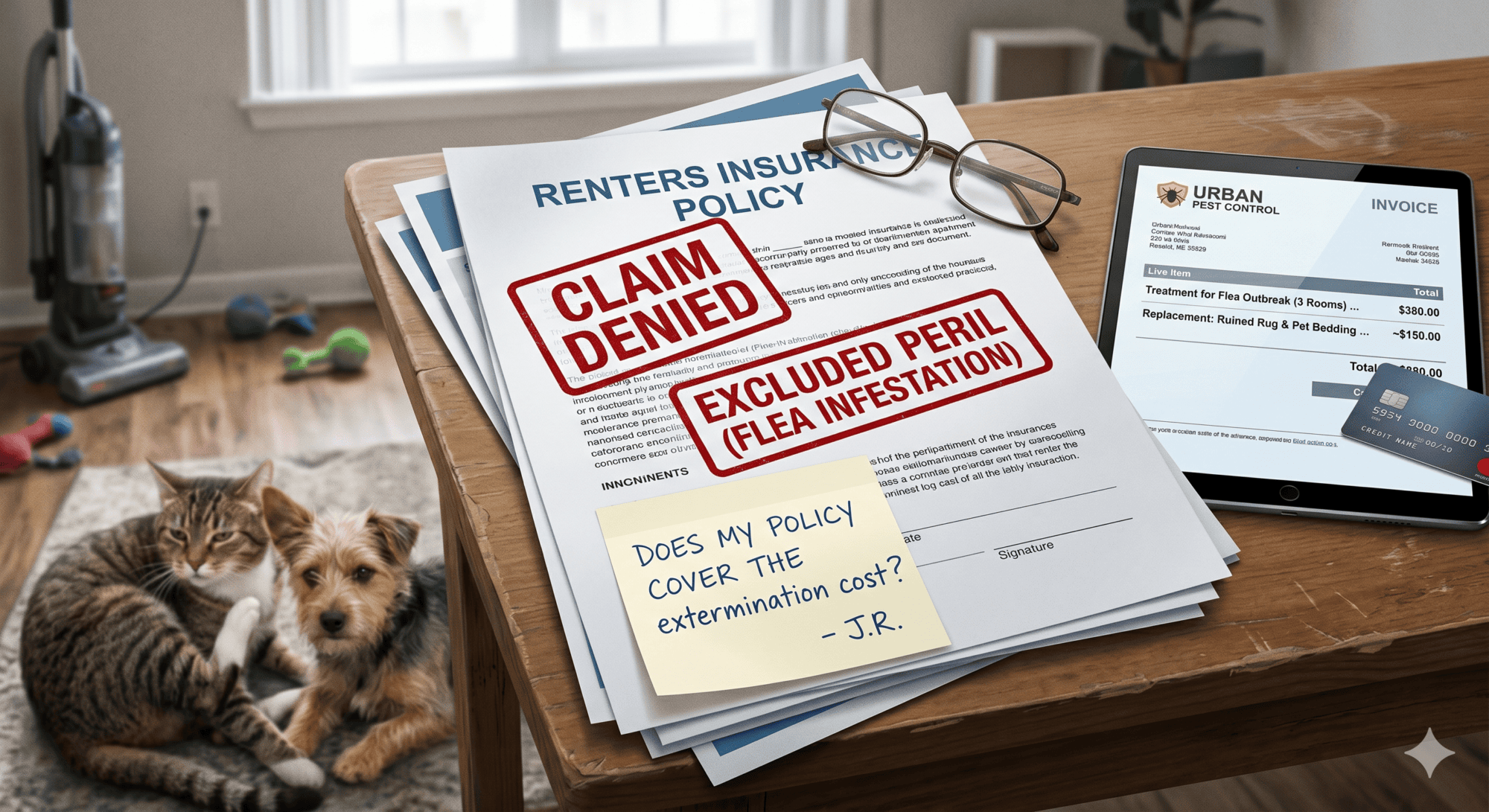
If you have discovered a flea infestation inside your rental property, your immediate response is likely a mix of frustration and panic. You are dealing with itchy bites, uncomfortable pets, and a clock ticking against an insect population capable of laying up to 50 eggs a day per female. Once the initial shock wears off, the financial reality sets in: professional extermination, deep cleaning, and replacing contaminated household goods can add up to hundreds or thousands of dollars.
Naturally, your next move is to look toward your financial safety nets. You pay your premium every month, so you ask yourself: does renters insurance cover fleas?
No, standard renters insurance policies do not cover fleas, extermination costs, or the damage they cause to your personal belongings. Insurance carriers classify pest infestations—including fleas, bedbugs, roaches, and rodents—as preventable maintenance hazards rather than sudden, accidental events. Consequently, pest eradication is entirely excluded from Personal Property, Liability, and Additional Living Expenses (Loss of Use) coverages.
While that baseline answer is straightforward, navigating an active infestation requires a deeper understanding of insurance contracts, tenant-landlord laws, and strategic risk management. This guide breaks down why insurance exclusions exist, the rare legal exceptions where a policy might apply, who is legally obligated to foot the pest control bill, and practical steps to save your assets.
The Mechanics of Risk: Why Renters Insurance Excludes Fleas
To understand why insurance companies deny flea claims, it helps to look closely at how a renters insurance policy (technically known as an HO-4 policy) is structured. Renters insurance is built around the concept of Named Perils. A peril is an event that causes damage. For an HO-4 policy to cover a loss to your personal property, that loss must be directly caused by one of the explicit perils listed in the policy document.
Standard covered perils typically include:
-
Fire or lightning
-
Windstorm or hail
-
Explosions or civil commotion
-
Theft or vandalism
-
Sudden, accidental tearing apart or cracking of plumbing/HVAC systems
Notice what is missing from this list: biological infestations, insects, and vermin. Insurance carriers draw a firm line between a sudden and catastrophic accident (like a pipe bursting or a kitchen fire) and a gradual maintenance issue. In the eyes of an underwriter, a flea infestation is an environmental hazard that develops over time, usually linked to pet ownership, local wildlife, or household upkeep. Because maintenance is the ongoing responsibility of the occupant, it is deemed an uninsurable risk.
The “Wear and Tear” Exclusion Clause
If you read the fine print on your policy’s Exclusions page, you will see language specifying that the policy does not cover damage resulting from “wear and tear, gradual deterioration, smog, rust, mold, wet or dry rot, or nests, infestations, or discharge of waste by insects, birds, rodents, or other animals.” This explicit insect exclusion eliminates any ambiguity regarding flea treatment or the replacement of bitten-up carpets, cat trees, or personal bedding.
The One Rare Exception: The “Chain of Causation” Rule
In the insurance industry, claims adjusters evaluate losses based on the “proximate cause”—the primary event that set a chain of damages into motion. While fleas themselves are excluded, a scenario can occur where a covered named peril directly introduces the infestation into your home.
Consider this specific scenario:
A severe windstorm rips a branch from a tree, smashing through your rental unit’s living room window while you are away for the weekend. Rain pours in, and a stray, flea-ridden animal seeks shelter inside the broken window, nesting in your sofa and leaving behind a massive cluster of fleas and larvae.
In this rare instance, the proximate cause of the entry and subsequent damage was a windstorm, which is a covered named peril. The structural breach allowed the biological hazard to manifest. When filing a claim under these circumstances, your personal property coverage might cover the sofa, and the remediation costs could potentially be grouped into the storm damage claim. However, the burden of proof rests entirely on you to demonstrate a direct, unbroken chain of events connecting the storm to the fleas.
Renters Insurance vs. Landlord Responsibility: Who Pays?
Since your HO-4 insurance policy will not clear out the pests, your next avenue of recourse is evaluating whether the property owner is financially liable. The allocation of pest control costs between a tenant and a landlord depends on two factors: lease agreements and the source of the outbreak.
Infestation Scenario Primary Responsibility Legal & Operational Rationale Tenant Owns Pets: Fleas brought inside by a household dog or cat. Tenant (You) Classified as an individual pet maintenance issue. The tenant failed to prevent the introduction of pests. Present at Move-In: Infestation discovered within the first few days of lease. Landlord Violates the Implied Warranty of Habitability. The landlord failed to deliver a clean, safe, and liveable environment. Multi-Unit Spread: Fleas migrate from an adjacent apartment or shared building space. Landlord / Adjacent Neighbor The source originates outside the tenant’s control. Landlords must manage structural integrity and multi-family common areas. Wildlife Invasion: Raccoons, bats, or feral cats nesting in crawls or attics. Landlord Maintaining the building envelope (roofs, foundations, walls) to keep out wild animals falls on the property owner.
Understanding the Implied Warranty of Habitability
In almost every state, landlord-tenant law mandates an Implied Warranty of Habitability. This is an unwritten, non-waivable legal doctrine ensuring that a rental unit meets basic human living standards. A severe, systemic insect infestation that causes physical injury (bites) or introduces disease risks can render a property legally uninhabitable.
If you do not own pets, keep a clean home, and discover that fleas are breeding in the floorboards from a previous tenant or migrating through shared walls from a neighbor, the landlord is legally obligated to hire and pay for a licensed exterminator. Failure to do so after proper written notice can grant you the right to withhold rent into an escrow account, repair and deduct the costs from your rent, or break your lease without penalty, depending on local municipal codes.
The Hidden Costs: Deductibles and Security Deposits
Even if you find yourself in a scenario where you believe insurance or your landlord should cover the issue, keep these two financial bottlenecks in mind:
1. The Insurance Deductible Constraint
If you ever encounter a highly unusual situation where a covered peril caused the flea problem, remember your deductible. Most renters insurance policies carry a deductible ranging from $250 to $1,000. If professional flea eradication costs $350 and your deductible is $500, your insurance policy will pay out nothing, as the cost of the loss is lower than your out-of-pocket threshold.
2. The Security Deposit Hazard
If your pets caused the flea issue and you vacate the property without completely resolving it, the landlord will hire an emergency pest control team and subtract the costs directly from your security deposit. If the fleas have laid eggs that hatch after you leave, ruining new carpeting or requiring specialized sealing of the subfloor, the landlord can sue you for damages that exceed your security deposit amount. Your renters liability insurance will not defend you or cover these costs, because liability coverage excludes damage to property you currently rent or occupy.
How to Deal with an Active Flea Infestation Immediately
When insurance is out of the picture, taking immediate, systematic action is the only way to limit your financial exposure and protect your home environment.
-
Issue Written Notice Immediately: If you believe the landlord is responsible (due to a multi-unit spread, wild animals, or pre-existing conditions), document the insects with photos and send a formal, written notice to your property manager. Do not rely on casual text messages or phone calls; create a clear paper trail.
-
Consult a Veterinarian: If you have pets, over-the-counter flea collars and grocery store treatments rarely break the flea life cycle. You need prescription-grade, systemic flea preventatives (topical or oral treatments) that disrupt egg-laying and kill adult fleas upon contact.
-
Implement the Vacuum Strategy: Vacuuming is your most powerful mechanical weapon. Vacuum all carpets, baseboards, rugs, upholstered furniture, and curtain bases daily. The vibrations from a vacuum cleaner stimulate flea pupae to emerge from their cocoons, exposing them to treatments. Crucial step: Empty your vacuum canister or bag into a sealed plastic bag and throw it into an outdoor trash bin immediately after every session.
-
High-Heat Laundering: Gather all pet blankets, bedsheets, clothing, and small rugs. Wash them using hot water and dry them on the highest heat setting your fabrics can handle. The intense heat of a modern dryer kills flea larvae and eggs instantly.
Frequently Asked Questions
Can I purchase a policy rider or endorsement to cover pest control?
No. Insurance carriers do not offer specialized endorsements, riders, or add-ons for pest control, bedbugs, termites, or fleas. Because pest management is categorized as regular home maintenance, it remains fundamentally uninsurable in the standard consumer market.
What happens if a guest claims my apartment’s fleas bit them?
If a visitor enters your apartment, suffers severe flea bites or an allergic reaction, and decides to sue you for medical bills, this touches upon your policy’s Medical Payments to Others or Personal Liability coverages. However, because policies explicitly exclude bodily injury arising from unmaintained hazards, insect infestations, or pet-related omissions, your carrier may deny defense and indemnity coverage. It is vital to manage flea outbreaks immediately to avoid third-party liability exposure.
Does renters insurance cover hotel stays during a flea treatment?
No. Your policy’s “Loss of Use” (Additional Living Expenses) coverage only triggers if your home is made uninhabitable by a covered named peril (such as a structural fire). If you must leave your apartment for 24 to 48 hours while a pest control team uses chemical bombs or treatments, those hotel expenses must be paid entirely out of pocket.
Disclaimer: Policy language, state insurance regulations, and local landlord-tenant statutes vary across jurisdictions. Always check your actual policy declarations page and consult with a licensed insurance agent or legal professional regarding your specific situation.
More Reading on… What Does Renters Insurance Cover?
In the Dayton, Ohio area? Greater Dayton Pest & Rodent handles flea treatment for homes and rentals. Outside our area, ask your pest control company for a written inspection report — you’ll need it for any claim or landlord dispute.
Does your policy actually say that?
Everything above is how renters policies generally work. Yours may read differently — carriers word coverage and exclusions their own way, and the endorsements you carry change the answer.
Send us your declarations page and we’ll read it and tell you, in plain language, what you actually have. If your coverage is already fine, we’ll tell you that too.
Have us review my policy — or email contact@insuredbyingram.com, or call (937) 741-5100.
Don’t have renters insurance yet? Get quotes in about three minutes — answer a few questions, set up your account, and see real rates from several carriers side by side.
Ingram Insurance Group — independent agency, 733 Salem Ave, Dayton, Ohio. No cost, no obligation.