

White squirrels aren’t a myth in Dayton, Ohio—you can spot flashes of white moving along maples and oaks from Oakwood to Kettering and beyond. Locals swap photos and stories, and a century-old legend ties these squirrels to industrialist John H. Patterson and the former NCR grounds. In Part 1 of this two-part deep dive, we explore where white squirrels come from, why they appear in Dayton, and what their presence says about our urban ecosystems. In Part 2, we’ll dig into Patterson’s sweeping legacy—from Deeds Barn and aviation pioneers to parks, golf courses, and museums that still shape life in the Gem City.
🎧 Listen to This Article
Prefer to listen instead of read? You can hear this story narrated on The Ingram Insurance Podcast – Dayton, Ohio.
The White Squirrels of Dayton, Ohio: A Rare Legend from NCR to the Neighborhoods
A modern sighting: a white squirrel photographed in a Dayton neighborhood.
A Flash of White in the Trees
Every so often in Dayton, someone looks up and does a double-take. It’s a squirrel, yes—but instead of the familiar charcoal or cinnamon coat, this one is bright white. It darts along a limb in Hills & Dales, scampers over a garage in Kettering, or pauses on a trunk in Oakwood just long enough for a photo before vanishing into the canopy. If you’ve seen one, you remember it. White squirrels turn an ordinary morning into a small civic event—neighbors text neighbors, neighborhood Facebook groups light up, and more than a few folks change their walking route hoping for another glimpse.
Dayton’s white squirrels carry a special kind of local magic because their story is layered with place, people, and folklore. Our region’s mature tree cover, ribbons of river and creek corridors, and older neighborhoods create excellent squirrel habitat. Add to that a persistent Dayton legend linking white squirrels to the visionary (and sometimes controversial) NCR founder John H. Patterson, and you get a uniquely local character—wildlife that feels like part of our shared heritage.
Myth, Memory, and the NCR Legend
Ask a longtime Daytonian why we have white squirrels and you’ll likely hear this: “Patterson brought them in.” The story goes that John H. Patterson—who reshaped industry standards and civic life from the NCR campus—imported white squirrels to symbolize innovation and to delight visitors strolling the model factory grounds. As with many beloved local legends, hard documentation is thin, and historians debate the details. But legends persist because they say something true about a place. Patterson did sculpt landscapes, fund civic projects, and set the tone for a culture of experimentation and hospitality. Even if the exact origin of Dayton’s white squirrels can’t be stamped with a purchase order from NCR, the idea that they’re part of Patterson’s landscape—real or remembered—keeps the story alive.
After the squirrels, we’ll explore Patterson’s broader legacy—his ties to Deeds Barn, the Wright brothers and Charles Kettering, the donation of land that became Community Golf Club, and family connections to the Dayton Art Institute. Understanding that landscape helps explain why squirrels thrive here—and why a white squirrel sighting in Dayton feels like more than chance.
What Makes a White Squirrel “White”?
Two biological mechanisms can make a squirrel appear white: albinism and leucism. Albino squirrels lack melanin entirely; they have pink or very pale blue eyes, pinkish ears, and noses. Leucistic squirrels have a reduction in all types of pigment, which can leave their fur white while their eyes, noses, and paw pads remain dark. Many “white squirrels” are actually leucistic Eastern gray squirrels (Sciurus carolinensis)—the same species we see every day in Dayton parks and neighborhoods.
White coloration is rare in the wild because camouflage matters. A white squirrel stands out to hawks, owls, and neighborhood cats, and it doesn’t blend as neatly into tree bark or leaf litter. Yet in cities and older suburbs like ours—where large trees meet fragmented predator habitats, and people tend to view unusual wildlife sympathetically—white squirrels can persist. That mix of mature canopy, backyard feeders, and protected parkland creates small pockets where rare traits can survive and even spread
Albinism vs. Leucism—How to Tell at a Glance
Eyes: Pink to red eyes often indicate albinism. Dark eyes suggest leucism. Skin and features: Pinkish nose and ear skin lean toward albinism; normal-colored noses and ears can indicate leucism. Patchiness: Some leucistic squirrels show patches of normal color—like a dark tail tip or a faint gray saddle—while albino squirrels are uniformly white.
In the photo above, the squirrel’s eye pigment appears dark, pointing to leucism rather than albinism—consistent with many Dayton reports.
Why Dayton Is a Haven for Squirrels
Dayton’s geography matters. The Great Miami, Stillwater, and Mad River corridors braid through the city, feeding a network of parks, riparian buffers, and street-tree canopies. In neighborhoods developed from the late-19th to mid-20th century—South Park, Oakwood, Grafton Hill, and many others—mature maples, oaks, and sycamores still dominate. That canopy creates “arboreal highways” for squirrels, letting them move safely from backyard to boulevard to park.
Layers of conservation add resilience: metroparks like Hills & Dales, Carillon Historical Park’s grounds, the NCR legacy campus landscapes, and the green edges around local schools and churches create a mosaic of habitat. A rare trait like leucism can gain a foothold in a district where food is abundant and predation pressures vary. Over time, a small family group can make “white squirrels” a neighborhood hallmark.
Sightings Across the Gem City
Scroll local social feeds long enough and you’ll see them: white squirrels staged against fall foliage or trotting along fence tops. While they remain uncommon, enough sightings dot the map—from Oakwood and Kettering to pockets of south-side Dayton and older suburbs—that “white squirrel country” feels plausible. Anecdotes put them near Hills & Dales, by schools with mature trees, and in older blocks where big canopy meets quiet yards. As with any urban wildlife report, there’s a feedback loop: the more people know to look for them, the more frequently they’re spotted.
Residents often develop protective instincts. Homeowners delay pruning, drivers brake a little sooner near mast-heavy streets, and kids learn to look twice before tossing a ball into a pile of leaves. That’s one of the subtle benefits of local wildlife: it changes our behavior in small, thoughtful ways that improve the overall ecology of a neighborhood. When I lived in Hills & Dales, it was always a family event when we spotted a white squirrel in our yard. All of our kids rushed to the windows to watch it do squirrel things.
From Rumor to Roots: Could Patterson Have Helped?
Even if we can’t prove that Patterson personally imported white squirrels, he undeniably shaped the grounds where NCR employees worked and guests strolled. The campus was famous for carefully planned landscaping, generous lawns, and demonstration gardens—early examples of workplace environments that prioritized light, air, and beauty. Whether the white squirrels arrived accidentally, by natural mutation, or by deliberate introduction, the landscape Patterson cultivated—and the civic ethos he spread—made room for delight. That’s what keeps the legend durable: it fits the man and the place.
White Squirrels Beyond Dayton
Dayton isn’t alone. Towns like Olney, Illinois and Brevard, North Carolina actively celebrate white squirrels, complete with festivals, local lore, and—crucially—community norms discouraging harm to these rare animals. Those examples matter because they show how a small, unusual population can become a beloved civic symbol. Dayton has never needed a mascot to substantiate its innovative spirit, but if the community ever chose to elevate white squirrels as a local emblem, there’s precedent for doing it in a way that’s fun and conservation-minded.
How to Spot One (Without Stressing the Squirrels)
White squirrels are most visible when leaves are down and light angles are lower—late fall through early spring. Scan along trunks and primary limbs where bark color contrasts white fur. Early mornings are ideal, especially after a calm, cold night. If you’re hoping for a photo, step slowly, stay quiet, and let the squirrel dictate the distance. Avoid calling, clapping, or extended chase; one of the best gifts you can give an uncommon animal is the freedom to ignore you. In fact – if you find one – send us a photo at and we will add it to the end of this article!
Ideal Places to Look
-
Neighborhoods with older canopy: Oakwood blocks near Far Hills, historic districts like Grafton Hill or South Park, and streets lined with mature maples.
-
Park edges: The boundaries of Hills & Dales MetroPark and other tree-heavy parks where squirrels forage between yards and wild spaces.
-
School and church grounds: Large oaks and maples on institutional campuses create reliable mast and safe travel corridors, especially on quiet weekends.
Conservation Notes: Keeping Rare Things Common Enough
Do white squirrels need special protection? In most cases, no more than any urban wildlife. But Dayton can improve habitat quality in ways that help all squirrels—and by extension, the rare white ones:
-
Plant diverse trees (oaks, hickories, walnuts, native maples) to support robust mast seasons.
-
Preserve deadwood and snags where safe; cavities make excellent dens.
-
Keep cats indoors and encourage responsible pet ownership—small actions with big biodiversity payoffs.
-
Drive with care on tree-lined streets, especially at dawn and dusk.
-
Share observations in local citizen-science apps (e.g., iNaturalist) to map where uncommon traits occur.
These choices aren’t about “protecting one special animal.” They’re about creating neighborhoods where many species thrive. White squirrels become a visible indicator that our urban forest still works.
Frequently Asked Questions About Dayton’s White Squirrels
Are white squirrels a separate species?
No. In Dayton, white squirrels are most likely leucistic Eastern gray squirrels. The species is the same; only the coloration differs.
Are they albino?
Some may be, but most reported individuals show dark eyes and normal skin pigment under the fur, indicating leucism rather than albinism.
Do white squirrels have health problems?
Albinism can sometimes be linked to visual sensitivity and greater predation risk. Leucistic squirrels generally behave like any other squirrel. The biggest challenge is visibility—standing out can be a liability.
How rare are they?
Precise numbers are hard to pin down, but white morphs are rare in most wild populations. In cities, small clusters can persist for years when habitat and social norms favor them.
Can I feed them?
If you feed backyard wildlife, offer natural foods (unsalted nuts in the shell) infrequently, keep feeding areas clean, and don’t crowd animals for photos. Native plantings that produce mast are better long-term support than handouts.
Is it illegal to harm a white squirrel?
Wildlife regulations vary by jurisdiction. Regardless of color, Eastern gray squirrels are protected by general wildlife laws against illegal take. The spirit of Dayton’s white-squirrel culture is simple: look, enjoy, photograph—let them be.
Why do some neighborhoods see more white squirrels than others?
Local genetics, tree structure, and predation pressure all play a role. A neighborhood that happens to host a leucistic pair—and supports them with mature trees and safe travel routes—can become a pocket of recurring sightings.
Neighborhood Pride and the Psychology of Rare Sightings
Why do white squirrels capture so much attention? Partly because rarity grabs our brains. We’re wired to notice what’s unexpected. But there’s a deeper civic dimension: a white squirrel feels like Dayton saying, “Pay attention—there’s more wonder here than you think.” That sense of place is priceless for local culture and even for local business. People who care about their streets care about their neighbors, parks, and schools. They join cleanups, buy local, and greet one another on the sidewalk. A flash of white can be the first thread in that larger civic fabric.
Photographing Dayton’s White Squirrels (Ethically)
Smartphone cameras have made it easy to document quick encounters. If you’re hoping for a clear shot:
-
Move slowly and avoid sudden gestures.
-
Turn off artificial shutter sounds and haptics.
-
Use natural light; avoid flash, especially at dusk.
-
Let the squirrel go about its business. A missed shot is better than a stressed animal.
Don’t forget to send the photo of your white squirrel sighting to to be featured at the end of this article! :)
How White Squirrels Fit Into Dayton’s Larger Story
Dayton has always balanced grit and grace: a city of workshops, mills, and labs set amid rivers, trails, and tall trees. White squirrels fit that identity perfectly—ordinary species with an extraordinary twist, thriving in landscapes sculpted by human hands and civic choices. Whether Patterson truly brought them here or simply built the stage on which they could appear, the squirrels connect us to a lineage of experimentation and care. They’re living folklore: a rumor that keeps running, tail held high.
Related Reading on Our Site
If you’re a Dayton homeowner or investor who loves our urban forest as much as we do, you might also like:
Now, we’ll zoom out from the treetops to the boardrooms, barns, and boulevards that made this city’s landscape what it is, and we’ll put the white-squirrel legend in the fuller context of John H. Patterson’s remarkable (and sometimes surprising) impact on Dayton.
John H. Patterson: The Man Who Built Dayton’s Spirit of Innovation (From Deeds Barn to Community Golf Club & Beyond).
John H. Patterson: The Man Who Built Dayton’s Spirit of Innovation
In Part 1, we explored the white squirrels of Dayton — their elusive presence, genetic quirks, and the enduring rumor that industrialist John H. Patterson himself imported them to the NCR campus. Whether myth or memory, that story reflects something deeper about Dayton: a place where innovation, generosity, and curiosity often intertwine. In this second half, we’ll explore Patterson’s far-reaching influence — from his partnerships with the Wright brothers and Charles Kettering to his philanthropic gifts of parks, golf courses, and museums that still shape our city today.
From Canal Boy to Corporate Visionary

Born in 1844 on a farm near Dayton, John Henry Patterson grew up in a world of mills, canals, and the early stirrings of American industry. He attended Miami University in Oxford, Ohio, graduating in 1867, and soon after began working in the family coal and canal-supply business. Those early years taught him two lifelong lessons: the value of meticulous recordkeeping and the power of good management. Both would later define the company he built — the National Cash Register Company, better known as NCR.
Patterson’s introduction to mechanical cash registers came when he installed one at his coal business to stop employee theft. The result was transformative — and so was his realization that these machines could revolutionize retail accounting. In 1884, he bought controlling interest in the failing National Manufacturing Company and relaunched it as the National Cash Register Company. What followed would set the tone for modern American business.
Building NCR and Reinventing Work
 Patterson didn’t just sell machines; he sold a philosophy. He created one of the first corporate sales schools, trained his workforce with military precision, and developed innovative employee-welfare programs decades before they became standard. NCR’s campus on South Patterson Boulevard was a model of industrial design: daylight factories with massive windows, landscaped grounds, clean cafeterias, and gardens open to employees and visitors. It was here that Patterson’s rumored “white squirrels” would have seemed most fitting — bright, rare, and emblematic of his obsession with order and beauty.
He also introduced practices that shaped corporate America: sales scripts, loyalty rewards, employee housing, and even early versions of performance bonuses. Yet Patterson was far from a gentle leader — he fired employees frequently, even luminaries like Charles F. Kettering and Thomas J. Watson (who later founded IBM). His perfectionism could be tyrannical, but his results were undeniable: NCR became an industrial powerhouse and a civic institution that mirrored Dayton’s ambition.
Dayton’s Innovation Ecosystem: Deeds Barn and Beyond
By the early 1900s, Dayton had become one of the most inventive cities in America. Its population of fewer than 150,000 produced more patents per capita than anywhere else. At the center of this explosion stood Patterson’s NCR and a cluster of minds he directly influenced.
The Deeds Barn and Kettering’s Spark
Just a few miles from NCR’s headquarters stood Deeds Barn, the workshop of Edward A. Deeds — an NCR executive and close associate of Patterson. In this modest outbuilding, Deeds and Kettering developed the electric automobile ignition system and, later, the self-starter that revolutionized the car industry. Patterson encouraged this kind of experimentation within his orbit, fostering an environment where invention and management went hand in hand. The work that began in Deeds Barn helped establish Dayton’s reputation as an innovation capital — and eventually led to the founding of Delco, later absorbed by General Motors.
The Wright Brothers Connection
While Patterson didn’t invent the airplane, he did support the Wright brothers at critical moments. He provided equipment, workspace, and influential introductions that helped secure backing for their aviation experiments. Patterson’s civic stature also helped keep Dayton at the center of early flight development when the brothers could easily have moved elsewhere. The collaborative ethos he nurtured — practical innovation grounded in community — became a Dayton hallmark and later found expression in institutions like Wright-Patterson Air Force Base.
Humanitarian Leadership: The 1913 Flood
When the Great Dayton Flood struck in March 1913, Patterson’s response transformed him from industrial titan to civic hero. As floodwaters engulfed downtown, he mobilized NCR’s resources with military precision. Factory workers built over 300 flat-bottomed boats to rescue stranded residents. The company’s cafeterias became emergency kitchens; its assembly halls turned into makeshift hospitals and shelters. Patterson himself oversaw logistics, dispatching supplies and ensuring the safety of thousands.
Historians estimate NCR spent nearly two-thirds of its annual profits on the flood relief effort — a staggering act of corporate compassion that earned Patterson national acclaim. His leadership inspired the creation of the Miami Conservancy District, which still manages regional flood control to this day. In the wake of disaster, he embodied Dayton’s defining virtues: ingenuity, generosity, and resilience.
Designing a Model Industrial Community
Patterson didn’t stop at business or philanthropy; he also reimagined what industrial communities could look like. He hired the Olmsted Brothers — the landscape architects behind New York’s Central Park — to design NCR’s campus and surrounding neighborhoods. Their plan integrated rolling lawns, tree-lined streets, and carefully placed worker housing, forming what would later inspire suburbs like Oakwood and Kettering.
Visitors to the NCR grounds marveled at the environment: gardens, open-air classrooms, and parkland woven between factory buildings. Patterson’s emphasis on aesthetics wasn’t vanity — it was strategy. He believed beautiful surroundings improved morale and efficiency. In that sense, the legendary white squirrels fit perfectly into his vision: a living symbol of a harmonious, well-tended world.
Gifts to the City: Parks, Golf, and Civic Space
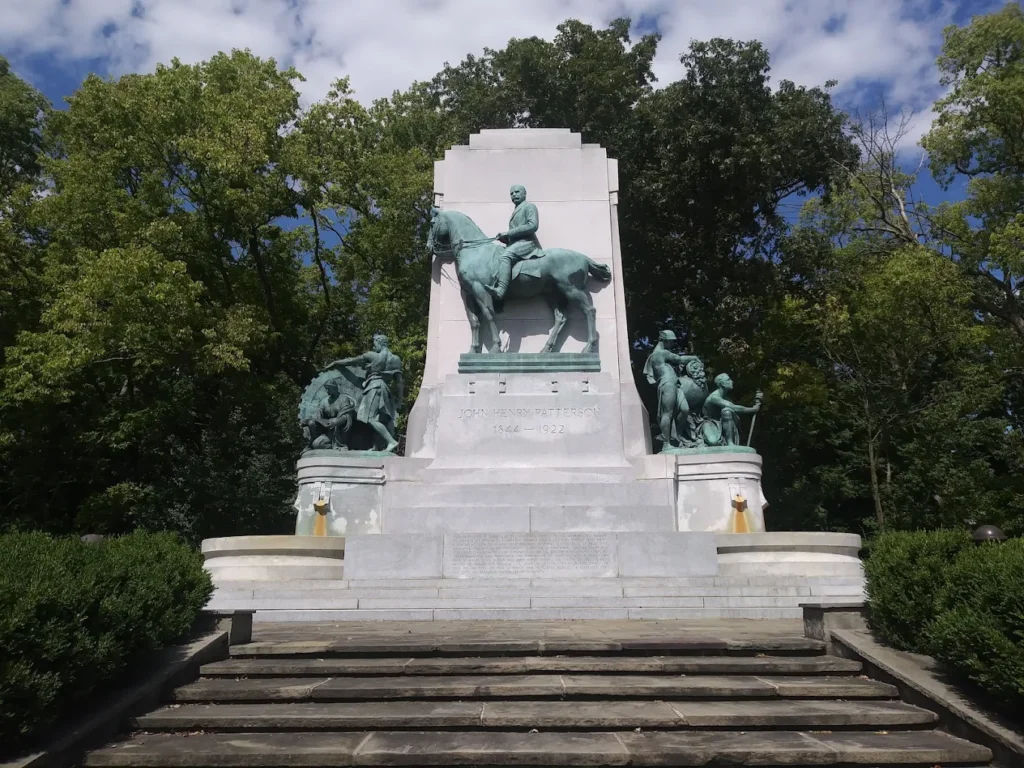
In 1918, Patterson donated nearly 300 acres of scenic hillside to the City of Dayton “for the happiness and prosperity of all the people.” That land became the Community Golf Club at Hills & Dales — today a 36-hole public course and one of Dayton’s most beloved recreation spaces. Patterson declined to have the park named after him, preferring that the land serve as a shared civic asset rather than a personal monument.
He also invested heavily in Hills & Dales MetroPark, commissioning rustic stone shelters and woodland trails designed for public access. Those same groves now host thriving wildlife — including the occasional white squirrel. It’s no exaggeration to say that Patterson’s land gifts helped preserve the green infrastructure that defines southern Dayton’s beauty today.
The Patterson Family and the Arts
Patterson’s civic spirit extended beyond engineering and recreation. His family shaped Dayton’s cultural life in enduring ways. His daughter, Dorothy Patterson, lent her name to Dorothy Lane, one of the city’s most recognizable corridors. His sister-in-law, Julia Shaw Patterson Carnell, funded the construction of the Dayton Art Institute building in 1929 — a gift that anchored the region’s artistic identity for generations. Between them, the Patterson family’s philanthropy wove together Dayton’s physical, intellectual, and aesthetic landscapes.
Patterson’s Homestead: From Family Home to Living Museum
Before NCR and philanthropy, there was Patterson Homestead — the family’s ancestral home on Brown Street. Built in the early 1800s, the homestead now serves as a museum operated by Dayton History. Visitors can explore original furnishings, heirlooms, and portraits that tell the story of one of Dayton’s most influential families. The house offers more than nostalgia; it stands as a physical reminder that progress and heritage can coexist.
Public Health, Parks, and Corporate Well-Being
Patterson was ahead of his time in workplace wellness. At NCR, employees were weighed semiannually, given nutrition guidance, and encouraged to spend time outdoors. The factory complex included exercise fields, fresh-air rest areas, and even “sanitary inspectors” to ensure a clean environment. He once declared, “You cannot have successful business unless you have healthy men.” While paternalistic by modern standards, his programs foreshadowed contemporary corporate wellness initiatives and the idea that companies share responsibility for community health.
Social Philosophy and the “Shrouds Have No Pockets” Ethic
Patterson was famous for saying, “Shrouds have no pockets.” He meant that wealth was a tool, not a trophy — something to be invested back into people and place. This mindset shaped everything from NCR’s employee housing to his public works donations. It’s the same philosophy that echoes through Dayton’s civic DNA today, visible in foundations, neighborhood associations, and the enduring generosity of local business leaders.
Legacy in Streets, Parks, and Memory
Walk through Dayton and you’ll see Patterson’s imprint everywhere. Patterson Boulevard connects downtown to Carillon Park. Dorothy Lane threads through Kettering, Oakwood, and Moraine. The NCR legacy lives on in the sprawling campus now home to the University of Dayton. Even the Carillon Historical Park itself owes part of its inspiration to the civic-minded industrialists Patterson influenced.
Patterson’s Legacy Around Dayton
Visit and Explore
-
Patterson Homestead — The family’s 19th-century home, now a museum operated by Dayton History.
-
Deeds Barn — Birthplace of the automobile self-starter and a monument to Dayton innovation.
-
Community Golf Club — 36 holes of public golf donated by Patterson “for the happiness and prosperity of all the people.”
-
Hills & Dales MetroPark — A green refuge designed with Olmsted influence and Patterson’s vision of shared beauty.
-
Dayton Art Institute — Founded through Patterson family philanthropy, housing one of the Midwest’s premier collections.
Connecting Back to the White Squirrel Legend
It’s no surprise that a city so shaped by Patterson’s imagination would develop wildlife stories that mirror his ethos. Dayton’s white squirrels — whether imported by him or descended from local anomalies — live in habitats he helped preserve. They inhabit the same trees that shade the golf course he donated, the same parklands he landscaped, and the same neighborhoods patterned after his industrial utopia. In that sense, the squirrels aren’t just curiosities; they’re inheritors of Patterson’s belief that industry and nature can coexist in beauty and purpose.
Patterson’s Influence on Modern Dayton
The civic architecture Patterson built — business balanced with benevolence — continues to define the region. NCR’s spirit lives on through the University of Dayton’s innovation centers, Dayton’s economic partnerships, and the cooperative mindset among the city’s small businesses. Even Ingram Insurance, a modern independent agency rooted in Dayton, operates within the framework of community-first enterprise that Patterson modeled over a century ago.
From flood relief to golf greens, from corporate gardens to tree-lined neighborhoods, Patterson proved that leadership is local. His story reminds us that every business decision ripples outward — shaping parks, streets, and even the wildlife that calls them home.
Final Reflection: From Industry to Ecology
John H. Patterson built more than a company; he built an ecosystem. The factories, parks, and civic landmarks he left behind still nurture Dayton’s physical and cultural landscape. When you spot a white squirrel in a maple tree near Oakwood or Hills & Dales, you’re seeing more than a genetic rarity. You’re seeing continuity — the long echo of a city that blends invention with stewardship, ambition with empathy.
Further Reading
About Ingram Insurance
Ingram Insurance is an independent agency located at 733 Salem Ave, Dayton, Ohio. We proudly serve our community with personalized Home, Auto, Life, Rental Property, and Business insurance solutions — built on the same local spirit of innovation and stewardship that defines Dayton. Whether you’re protecting your home, your investment property, or your future, our team is here to help.
Contact Us:
Phone: (937) 741-5100
Email:
Website: www.insuredbyingram.com
Request a Quote: Fill Out a Form Here or Call
Protecting what matters most — right here in Dayton.
Reader Sightings: Dayton’s White Squirrels in the Wild
Have a photo to share? Email it to and we may feature it here.
Backyard fountain visitor, Kettering. Photo: Local contributor

Spotted through the window, Hills & Dales Park. Photo: Local contributor
Photos Below of white squirrels spotted in Shroyer Park near Kling Dr: Photo from Local Contributer


Photos above submitted from the yard of a Dayton local.
Additional articles from Ingram Insurance:
Dry Cleaning Insurance
Ohio HVAC Insurance
Tractor Insurance
Boat Insurance
Drywall Contractor Insurance
Does Renters Insurance Cover Firearms?