
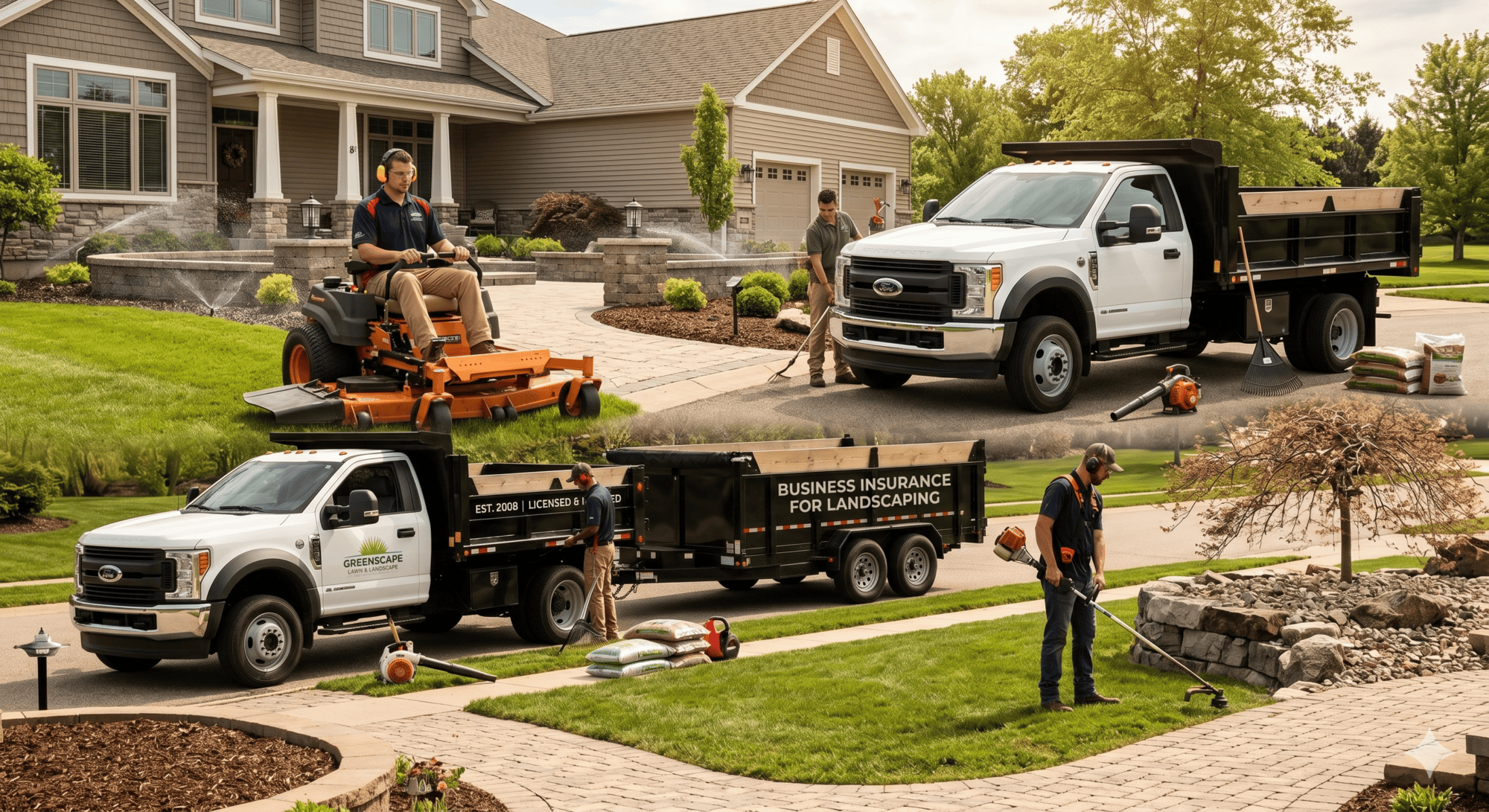
The Ultimate Guide to Landscaping Company Insurance: Protecting Your Green Business
For a landscaping business owner, every day presents a masterclass in risk management. One afternoon your crew is operating a commercial zero-turn mower near a client’s pristine, floor-to-ceiling glass windows. The next morning, a team is applying specialized fertilizers, or excavating a trench near underground utility lines for a new irrigation system.
The landscaping, lawn care, and hardscaping industry is inherently physical, highly mobile, and filled with variables you cannot always control. While you focus on transforming outdoor spaces and growing your revenue, a single structural accident, an employee injury, or a broken utility line could completely derail your hard work.
That is where securing the right business insurance for landscaping steps in. Far from just an administrative box to check, a robust insurance portfolio acts as the ultimate financial safety net for your business. Let’s break down everything you need to know about landscapers insurance, what it covers, why your business needs it, and how to build a bulletproof policy that shields your livelihood.
1. What is Landscaping General Liability Insurance? (The Foundation)
If you only buy one type of coverage when launching your business, it must be landscaping general liability insurance. This policy serves as the absolute bedrock of any commercial insurance program, shielding your company from the most common everyday risks associated with working on someone else’s property.
Generally liability focuses primarily on three core areas:
-
Third-Party Bodily Injury: If a client, a delivery person, or a random passerby trips over an edger, steps into an unfilled hole your crew dug, or gets struck by a piece of flying debris from a weed trimmer, you are responsible for their medical bills. General liability covers those immediate medical costs, plus legal defense fees if they decide to sue your business.
-
Third-Party Property Damage: Landscapers work in close proximity to expensive property. If an employee backs a truck into a client’s custom brick mailbox, accidentally cuts through an underground fiber-optic cable, or causes structural water damage by improperly grading a lawn, this coverage pays to repair or replace the damaged property.
-
Advertising and Personal Injury: This protects you against non-physical claims, such as accidental copyright infringement in your marketing materials, or slander and libel if an employee makes disparaging remarks about a competitor online.
Why You Can’t Work Without It
Beyond the obvious financial protection, operating without general liability is practically impossible if you want to grow. Most commercial clients, property management firms, and affluent residential homeowners will demand to see a Certificate of Insurance (COI) proving you carry general liability before they will let your crew set foot on the property. Furthermore, local municipalities and state licensing boards often require proof of general liability to grant or renew your professional landscaping license.
2. Expanding Your Coverage: A Full Landscaping Company Insurance Portfolio
While general liability is essential, it is a common misconception that it covers everything. It only covers third-party claims. It won’t pay to fix your stolen mower, fix your wrecked truck, or cover an employee who hurts their back lifting heavy flagstone.
To achieve true peace of mind, a comprehensive program for landscaping company insurance should blend several specialized coverages.
Commercial Auto Insurance
Your work trucks are the lifeblood of your operation. They pull heavy trailers, transport volatile chemicals, and log thousands of miles a year in stop-and-go local traffic.
Personal auto policies explicitly exclude business use. If you or an employee are driving a truck to a job site and cause an accident, your personal insurance company will likely deny the claim. Commercial auto insurance steps in to provide:
-
Liability coverage for bodily injury and property damage caused to others in a wreck.
-
Collision and comprehensive coverage to repair your own trucks after an accident, vandalism, or a weather event.
Inland Marine Insurance (Tools and Equipment Coverage)
Landscapers travel with thousands of dollars of equipment every single day—commercial mowers, skid steers, chainsaws, blowers, and hand tools. Standard commercial property insurance only covers items while they are physically inside or within a few feet of your primary shop or office.
When your gear is in the bed of a truck, parked on a trailer at a job site, or stored in a temporary container overnight, it requires Inland Marine Insurance. This specialized policy protects your tools from theft, vandalism, and accidental damage while they are in transit or actively deployed in the field. Given the high rates of equipment theft from landscaping trailers, this coverage is non-negotiable for mobile crews.
Workers’ Compensation Insurance
Landscaping is grueling, physical labor. Employees routinely handle heavy machinery, work in extreme heat, lift heavy materials, and operate cutting tools. Even with the absolute best safety protocols in place, accidents happen.
Workers’ compensation is typically mandated by law in almost every state as soon as you hire your first employee (and in some states, even if you utilize independent contractors). It provides two critical functions:
-
It pays for medical treatments, rehabilitation costs, and a portion of lost wages for an employee who is injured on the job.
-
It protects your business by limiting the worker’s right to sue you for negligence regarding the injury.
Commercial Property Insurance
Whether you own a large commercial warehouse to store your fleet and bulk mulch, or lease a small office space to handle your billing and customer service, you need to protect your physical home base. Commercial property insurance covers your buildings, office furniture, computers, and inventory (like plants, fertilizers, and pavers stored on-site) against perils like fire, windstorms, and theft.
3. Specialized Coverages Every Landscaper Should Consider
No two landscaping companies are exactly alike. A business that focuses exclusively on weekly lawn mowing faces completely different risks than a large-scale design-build firm installing heavy retaining walls and outdoor kitchens. Depending on your specific services, you may need to add specialized endorsements or riders to your landscapers insurance policy.
Herbicide and Pesticide Application Coverage
If your company offers chemical lawn care treatments, weed control, or pest management, standard general liability won’t cut it. Most standard policies include a strict “pollution exclusion.” If a chemical overspray drifts onto a neighbor’s award-winning rose garden, kills a row of expensive ornamental trees, or runs off into a client’s koi pond, a basic policy will deny the claim. You need an endorsement for herbicide and pesticide applicator liability to cover chemical drift and pollution incidents.
Errors and Omissions (E&O) / Professional Liability
This is particularly critical for landscape architects and design-build firms. If you draw up a digital blueprint for a major drainage project, and your calculations are off—resulting in a client’s basement flooding three months later—the client will sue you for your faulty design. General liability covers accidental damage caused by manual labor, but E&O covers financial losses resulting from your professional advice, designs, blueprints, and consultations.
Employment Practices Liability Insurance (EPLI)
As your business expands and your workforce grows, your exposure to employment-related lawsuits increases. EPLI protects your company if an employee or job applicant sues your business for issues like discrimination, wrongful termination, sexual harassment, or wage disputes.
4. Real-World Risk Scenarios: Why Cutting Corners Costs More
To truly understand the value of comprehensive business insurance for landscaping, let’s look at how these coverages perform in common, real-world situations.
+------------------------------------------------------------------------------------+
|                                RISK SCENARIO MATRIX                                |
+------------------------------------+-----------------------------------------------+
| What Happened?                     | Which Policy Saves the Day?                   |
+------------------------------------+-----------------------------------------------+
| A rock shoots out from a mower     | Landscaping General Liability Insurance       |
| and shatters a triple-pane window  | (Third-party property damage)                 |
+------------------------------------+-----------------------------------------------+
| Thieves cut the lock on your       | Inland Marine Insurance                       |
| trailer and steal three blowers     | (Tools and equipment coverage)                |
+------------------------------------+-----------------------------------------------+
| A worker severely strains their    | Workers' Compensation Insurance               |
| back lifting a 150 lb concrete step| (Employee medical and wage recovery)          |
+------------------------------------+-----------------------------------------------+
| An employee loses control of the   | Commercial Auto Insurance                     |
| dump truck and rear-ends a sedan   | (Vehicular liability and collision)           |
+------------------------------------+-----------------------------------------------+
Without the right coverage, paying just one of these claims out-of-pocket could easily wipe out an entire season’s profit margin—or worse, force a growing landscaping company into bankruptcy.
5. How Much Does Landscaping Insurance Cost?
Every business owner wants to know the bottom line. Because the landscaping industry encompasses everything from a single college student mowing lawns on weekends to multimillion-dollar commercial site developers, there is no one-size-fits-all price tag.
Insurance underwriters calculate your premiums based on a unique mix of risk factors:
-
Your Gross Revenue: Higher revenue typically means you are managing more jobs and larger properties, which increases your overall risk exposure.
-
Payroll and Employee Count: Workers’ compensation premiums are tied directly to your total payroll and the specific job classifications of your team (e.g., administrative staff vs. tree care specialists).
-
Specific Services Offered: Tree removal (working at heights) and heavy excavation carry significantly higher premiums than basic turf mowing and seasonal mulching.
-
Your Claims History: A clean record with zero past claims signals to insurance carriers that you run a tight ship, unlocking safer, lower premium tiers.
-
Location: Operating in highly litigious urban markets or regions prone to extreme weather events can influence your base rates.
The best way to secure accurate pricing that matches your exact business setup is to work directly with an experienced commercial agent. You can explore tailored options and secure specialized industry coverage by visiting Ingram Insurance’s Landscaping Services Program.
6. Smart Risk Management: Proactive Ways to Lower Your Premiums
Buying insurance is only half the battle. The most successful landscaping companies practice proactive risk management. By actively reducing the likelihood of accidents on your job sites, you can protect your crew, delight your clients, and keep your long-term insurance premiums as low as possible.
Implement a Rigid Safety Program
Create a culture where safety is prioritized over speed. Hold brief, mandatory “tailgate safety meetings” every Monday morning to review equipment handling, proper lifting techniques, heat stroke prevention, and personal protective equipment (PPE) requirements.
Standardize Equipment Maintenance
Keep detailed, digital logs of all equipment inspections and service history. Dull mower blades, loose guards, leaking hydraulic lines, or faulty safety switches on machinery dramatically increase your risk of an operational accident.
Screen and Train Your Drivers
Before handed over the keys to a company truck and trailer setup, run a Motor Vehicle Record (MVR) check on new hires. Provide hands-on training for backing up large trailers and securing heavy machinery properly using heavy-duty tie-down straps.
7. Choosing the Right Insurance Partner
When shopping for insurance, it is incredibly tempting to simply buy the cheapest, most basic online policy you can find. However, cookie-cutter insurance often leaves massive gaps in coverage that you won’t discover until you try to file a claim.
Look for an independent insurance agency that truly understands the green industry. A knowledgeable partner will walk through your day-to-day operations, ask the right questions about your equipment, and ensure your business is fully shielded.
Are you ready to protect your landscaping business with a policy engineered for your unique needs? Reach out to the commercial experts at Ingram Insurance today to get a customized quote and build a solid foundation for your company’s future.
8. Frequently Asked Questions: Landscaping Insurance Costs and Requirements
What kind of insurance do i need for landscaping business?
At a bare minimum, you need landscaping general liability insurance to protect against third-party bodily injury and property damage claims. However, a complete insurance portfolio should also include commercial auto insurance for your work vehicles, inland marine insurance to cover your tools and equipment while in transit, and workers’ compensation insurance if you have any employees. If you mix or apply lawn chemicals, you should also look into specialized pesticide/herbicide applicator coverage.
What insurance do you need for a landscaping business to get licensed or win contracts?
While requirements vary by state and municipality, most local licensing boards and commercial clients will require proof of a general liability policy (often with a minimum $1,000,000 or $2,000,000 limit) and workers’ compensation insurance before you can pull permits, maintain your professional license, or step foot onto a commercial job site.
How to get insurance for landscaping business operations?
Getting your business insured is a straightforward process, but it requires accurate details about your operations. You will need to gather your business entity details, estimated annual revenue, total payroll, claims history, and a list of your most valuable equipment. From there, the best step is to work with an independent commercial agency that can shop multiple top-rated carriers to find a policy built specifically for green industry risks.
How much is insurance for a landscaping business?
Because risks vary wildly between basic turf care and high-end hardscaping, costs are highly individualized. For a solo operator offering basic lawn care, a standalone general liability policy can start as low as $400 to $800 annually. However, as you scale into a mid-to-large sized firm with a fleet of trucks, heavy excavation machinery, and a crew on payroll, a comprehensive commercial package will adjust to reflect that expanded footprint.
How much is insurance for a small landscaping business with a tight budget?
If you are running a smaller setup, you can often package your general liability and commercial property protections together into a single, discounted policy called a Business Owner’s Policy (BOP). This is generally the most cost-effective way for a small business to secure essential foundational coverages without paying for multiple separate policies.
How much does insurance cost for a landscaping business when adding employees?
The moment you hire your first team member, your insurance dynamics change because you must account for workers’ compensation insurance. Workers’ comp costs are determined by your total payroll and specific risk classifications (for instance, tree trimming crews carry a higher rate than lawn mowing crews). Implementing strict safety programs and maintaining an accident-free record are the most effective ways to keep these costs low as your workforce expands.
How much is small business insurance for landscaping equipment and trailers?
Adding inland marine insurance (tools and equipment coverage) depends entirely on the total replacement value of your gear. Insuring a few thousand dollars worth of hand mowers and blowers costs very little, while covering an expensive setup like a brand-new zero-turn fleet or a skid steer will require a slightly higher premium. This coverage is essential, as standard property insurance won’t pay out if your tools are stolen right out of your trailer on a job site.





